You are viewing 1 of your 1 free articles
APPG calls on sector to build more intergenerational communities
The All-Party Parliamentary Group (APPG) on Housing and Care for Older People has called on developers, social housing providers and planners to create more intergenerational communities.


 APPG calls on sector to build more intergenerational communities #UKhousing
A new inquiry report has made a number of recommendations to support the shift from “mono-generational to intergenerational communities”, in order to address the undersupply of housing for older people in England.
It called on all stakeholders to recognise intergenerational communities as “essential social infrastructure that fosters inclusive and reciprocal relationships”.
The APPG report argued that the new Social and Affordable Homes Programme should explicitly incentivise these communities via a new assessment criteria, and prioritise funding that supports a mix of older persons’ housing within developments across all tenures.
Local authorities should also introduce explicit policy requirements for “intergenerational placemaking” through local plans, planning guidance and site allocations, the report said.
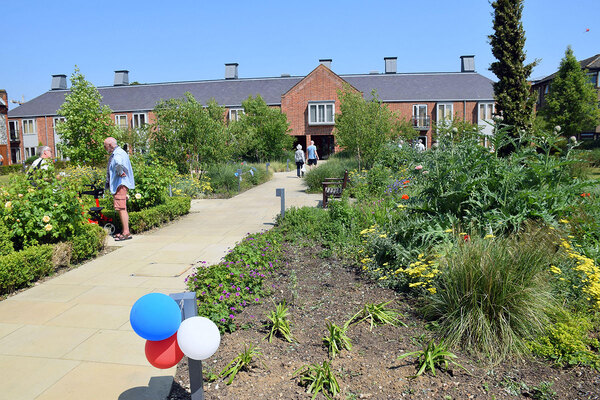
Population projections show that the number of people aged over 65 is expected to nearly double from around 10 million in 2020 to around 19 million by 2050.
The APPG highlights several benefits of intergenerational communities, including reduced loneliness, better support networks and more opportunities for skills-sharing.
But the inquiry, which launched a year ago, heard evidence that mainstream housebuilding favours the delivery of single-age group and single-tenure models as they are “perceived as lower risk and easier to finance”.
The Ministry of Housing, Communities and Local Government is being urged to recognise the need for a balance of new mainstream and specialist older persons’ housing to create intergenerational communities in its forthcoming National Housing Strategy.
Mayoral combined authorities should also “explicitly embed intergenerational placemaking into master planning”, according to the report.
Its recommendations include the need for social housing providers and developers to build to high accessibility and adaptability standards, including the M4(2) standard as a minimum.
For social providers or specialist older persons’ housing, the report said: “Work in partnership with local authorities, health bodies and mainstream house builders to integrate specialist older persons’ housing within mixed-tenure developments, ensuring allocations, funding and service models enable different age groups to live well alongside one another.”
“Social landlords should work with local authorities to develop flexible local allocations and lettings policies that enable access to specialist older persons’ housing or intergenerational communities that ‘share the building’,” the report added.
Lord Best, co-chair of the APPG, said: “The way we build homes today is too often driving generations apart, and that has real costs for all of us, young and old alike.
“This inquiry shows that it doesn’t have to be this way. Where developers and planners have the vision to create genuinely intergenerational communities, the results are remarkable: mutual help with everyday activities, reduced loneliness, savings for health and care budgets and more rewarding lives for all.
“We are calling on mainstream house builders, social housing providers and planners to embrace this opportunity. Building homes that work for all ages isn’t just good for older people. It adds value to every community, for every generation.”
John Glenton, chief care and support officer at Riverside, said the housing association has seen that intergenerational experiences can be “transformational” for residents.
He continued: “If the UK is to address the chronic shortfall in the supply of extra-care housing and other forms of supported housing for both older and younger people, then it is absolutely essential that long-term sustained revenue funding is provided alongside capital funding.
“This funding certainty is vital so that large providers of supported housing like Riverside can invest in new facilities and upgrade existing facilities in locations which we know have a viable future.”
Rachel Crownshaw, group managing director of communities at Places for People, said: “With planning reform now moving forward and greater funding certainty, we have a generational chance to accelerate social and affordable housing, including the later-living homes our ageing population needs.
“Policymakers, house builders and providers must use this moment to create truly intergenerational communities with real housing choice.”
Sign up to Inside Housing’s Care and Support newsletter
Sign up to Inside Housing’s Care and Support newsletter, a fortnightly bulletin featuring care and support news and analysis.
Already have an account? Click here to manage your newsletters.
Related stories