How one of the UK’s best-known housing associations is overhauling resident engagement
One of the UK’s oldest and highest-profile housing associations, Peabody, is looking to transform the way it does resident engagement. Martin Hilditch finds out what this means for resident-facing staff, residents and satisfaction scores


 How one of the UK’s best-known housing associations is overhauling resident engagement #UKhousing #HousingManagementMattersPeabody is looking to transform the way it does resident engagement. Martin Hilditch finds out what this means for resident-facing staff, residents and satisfaction scores #UKhousing #HousingManagementMatters
Dating back to 1862, Peabody is a housing association with a long and proud history. But when it comes to housing management, it is looking to rethink the way it works, with its eyes firmly focused on the future.
The results will have a profound impact on the way resident-facing staff at the 109,000-home housing association operate and the structures they work in. They will also share ideas and learning for people working in similar roles at other social landlords to reflect on.
To find out more about what Peabody is doing, what it means for resident engagement, and progress to date, Inside Housing Management spoke to Anna de Souza, head of resident engagement at Peabody, and deputy chief executive Elly Hoult, who began her career in housing management.
The starting point for our conversation is the landlord’s new resident engagement strategy, which was co-designed with residents. It launched last year and runs through to 2028.
Overall, it sets out two key strategic priorities: listen well and act clearly. This is an objective that fits in very directly with what the Regulator of Social Housing wants landlords to prioritise – social landlords have to record the proportion of residents who are satisfied that their views are listened to and acted upon as part of the tenant satisfaction measures (TSMs).
What does this actually mean in practice? In its strategy, Peabody defines “listening well” as gathering meaningful, representative feedback from a wide range of residents in a way that suits them and promises to make sure “listening to residents becomes an integral part of how we work as the organisation”. The next step is “acting clearly”, which means taking action on that feedback and showing residents the impact that their engagement has had.
“The resident engagement model is [designed] to ensure that resident voices shape decisions at every level of the organisation,” Ms de Souza says.
In order to do this, the new model looks to work on three different levels: strategically, regionally and locally. The strategic level involves having residents on the main board of Peabody and a resident-led panel with strategic oversight of engagement across the organisation.
“Last year they carried out an independent health check of resident engagement and they surveyed 25 teams across Peabody,” Ms de Souza says. “They analysed the feedback and co-designed five resident-led recommendations.”
These included having resident engagement objectives for all staff, not just resident engagement teams, and a focus on improving communication with residents by “closing the loop”.
“By that we mean that for any activity where we involve residents, we go back to them and show them how their engagement has been impactful and what difference it has made,” Ms de Souza adds. “Where it hasn’t made a difference, we’ll say what our plans are to work with them [to do so].”
“We’re targeting local engagement where insight shows that it is most needed”
More broadly, it is an action plan that the resident engagement team, in partnership with the resident-led panel, is responsible for implementing and “driving that change throughout the organisation”. Peabody’s resident engagement team is now delivering training for all colleagues and has created a ‘Peabody passport’ to encourage new colleagues to attend resident meetings, community events and estate walkabouts.
Residents are involved in recruitment panels, but given the huge scale of the organisation, this might not be possible for every role. But there is a potential solution to this, too. Later this quarter, Ms de Souza says, the team will work with residents to design interview questions for all resident-facing roles, such as neighbourhood managers, caretakers and repairs inspectors.
Peabody has set up four regional resident forums covering the Home Counties (which includes Reading, Oxford, Bedfordshire, Hertfordshire and Essex), south London, north-east London and north-west London. These forums oversee regional action plans and Peabody’s four regional managing directors are accountable to them.
But it is at the third level, the local level, that there are the most immediate implications and learning for people working in housing management.
For starters, Peabody wants to make sure there are many more resident-led structures on the ground for staff to engage with. At the moment the landlord has around 80 tenant and resident associations (TRAs) and informal resident groups, Ms de Souza says, but she wants to see a huge rise in that number.
“We’ve just increased the support that we will offer our [TRAs] by increasing their annual grant and by increasing opportunities for more training and support from the resident engagement team.” By 2028, Peabody is promising to support 150 TRAs with annual funding, almost double the status quo, and plans to deliver more than 100 local engagement activities a year.
The ambition is also to create local information updates across Peabody’s 140 neighbourhoods. This real-time information system, in the form of focused web pages co-designed with residents, will be trialled across five neighbourhoods from this month (with the potential added bonus of reducing calls to the contact centre because more specific local information will be more easily accessible).
The pilot will be done within the existing team (and existing budgets), but the learning will inform what additional resources might be needed for a wider roll-out.
Read More


It is also important for resident engagement teams to think about groups and individuals whose voices are “seldom heard” within the system. Language is important when it comes to this area, Ms de Souza says. “Hard to reach”, a phrase often heard in the sector, is banned at Peabody. Instead, she says it may be organisations that are “hard to access”.
“So, to widen our reach, we created a more engaging and accessible offer,” Ms de Souza adds. “We’re targeting local engagement where insight shows that it is most needed.” This might include local areas that have recorded particularly low ‘listen and act’ scores as part of the TSM process.
Ms Hoult says Peabody’s approach to resident engagement is “constantly adapting and evolving”. This perhaps is one of the key takeaways: the job is never done, but is always a work in progress.
“We do have lots of different residents and we’re certainly not perfect,” Ms Hoult adds. “We’re always trying to think about ways that we can engage with those seldom-heard voices. But I do think we have a good basis to build on and keep evolving.”
These are obviously all great intentions, but how will Peabody measure success? And how will resident-facing staff know what good looks like?
Colleagues opening up about how they have approached things at a local level are the starting point. Peabody holds a monthly webinar with staff, during which good examples of listening and acting are shared.
“After every engagement activity, [staff] will feed back on what outcomes have come out of it and what difference it has made to residents,” Ms de Souza adds. “To do all of this, we are providing more support with resident engagement training to really upskill colleagues and support them.”
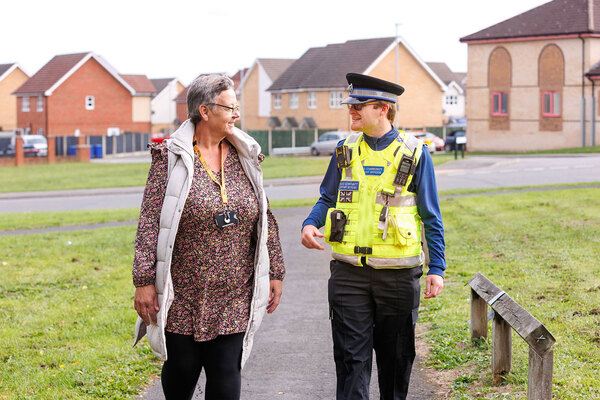
What does this look like in practice? Ms de Souza cites the example of a housing estate in north-east London that had a low ‘listen and act’ TSM score. Residents reported low awareness of local teams and poor communication.
So, Peabody introduced regular local drop-in surgeries, involving the neighbourhoods and repairs teams, and other teams such as homeownership and asset investment, Ms de Souza says. “This was literally to open up and say, ‘We’re here, we’re visible. We’ve got teams from these different areas and we want to talk to you and address your local issues.’”
There was also a tenant and resident association that had not been active for some time, so Peabody provided it with a start-up grant and worked with the chair and vice-chair on training to relaunch the TRA. Staff supported with knocking on doors across the estate to raise awareness of the TRA and what it could offer. As a result of all the activity, satisfaction that Peabody listens to residents and acts on their feedback jumped from just 23% in 2024-25 to 58% in 2025-26 on the north-east London estate.
“When a resident approaches us and wants to work with us, [it is important] that we take accountability for resolving issues, going back to them and showing them how engagement has been impactful”
Outside London, another practical example of action came in Hitchin, Hertfordshire – a small market town of 35,000 people. Given the town’s location about half an hour from London by train and a short hop from Luton and Stevenage, many of its residents are employed across a wide area, and told Peabody they were finding it difficult to take part in drop-in sessions that were typically held when they were at work.
As a result of the feedback, the local team started to hold early evening drop-in sessions, attended by a range of teams, including neighbourhoods, repairs, service charges and homeownership.
Residents raised issues relating to repairs, parking and other local services. To help as many people as possible to take part, more online surgeries were also set up. As a result, feedback that Peabody listens to residents in the Hitchin area and acts on their views jumped to 57.4% in 2025-26, up from 41%.
“Maybe not everyone attends, but word of mouth will spread [and residents will know,] ‘They were here, they were visible. I got this fixed,’” Ms de Souza says. “Word of mouth, whether that is through a TRA or just neighbours talking to each other, really does help with increasing confidence, which is our goal.”
Given that many of Inside Housing Management’s readers are looking to improve their own resident engagement, are there any thoughts Ms de Souza has on how to drive improvement?
Most important is targeted local engagement and raising the visibility of local teams on the ground, she says. Creating or supporting forums for residents to come together and talk about what is happening in their communities is also crucial. When those forums or individuals interact with staff, it is important for there to be “no hierarchy, no us-and-them”, she says.
“On our side we’re trained and feel confident engaging with residents during resident meetings,” Ms de Souza adds.
Finally, it is important that all staff take accountability for acting on residents’ queries.
“When a resident approaches us and wants to work with us, [it is important] that we take accountability for resolving issues, going back to them and showing them how engagement has been impactful.”
Are you subscribed to Inside Housing Management?
Inside Housing Management is the go-to source for learning, information and ideas for housing managers. Not subscribed yet?
Related stories