Awaab’s Law pressures, competence and conduct, and ‘hidden’ careers: lessons from the North
Housing management issues including Awaab’s Law and the Competence and Conduct Standard dominated the agenda at the Northern Housing Festival in Gateshead this week. Anna Highfield explores some key talking points


 Anna Highfield explores the key housing management talking points from the Northern Housing Festival #UKhousingHousing management issues dominated the agenda at the Northern Housing Festival #UKhousing
Housing professionals from across the North of England descended on a sun-soaked Gateshead for the two-day Northern Housing Festival this week (17-18 March).
Housing management themes were dominant on the agenda, with key discussions revolving around Awaab’s Law, the Competence and Conduct Standard for social housing, tenant satisfaction measures (TSMs), and the future of recruitment for young housing professionals.
Inside Housing Management has rounded up some of the key talking points.
Competence and conduct is ‘a balancing act’
Preparing for the Competence and Conduct requirements for social housing is a “balancing act”, according to Emma O’Sullivan, neighbourhood housing manager at Gateshead Council.
Ms O’Sullivan is currently working towards a CIH Level 4 qualification, as one of 27 housing managers at the council required to gain a qualification as part of the incoming legislation.
Speaking on a panel about the competence and conduct requirements, Ms O’Sullivan admitted that “it’s a lot of work to fit in as well as doing the day job, and I’m not used to doing assignments and qualifications”.
The housing manager said that studying topics that she is “not used to” in her usual role, including finance and law, has proved particularly time-consuming – and that the time commitment needed from staff members “can create pressure within the team overall”.
“It’s a lot of work to fit in as well as doing the day job, and I’m not used to doing assignments and qualifications... [but] it gives me confidence in my ability and knowledge as a manager”
However, Ms O’Sullivan said “the positives do outweigh the negatives”. She said the qualification is giving her a renewed “confidence... in my ability and knowledge as a manager”, which in turn should give her team, and her wider organisation, confidence in her abilities.
Ms O’Sullivan said this confidence boost has been mirrored among her team members taking their CIH Level 3 qualifications, who are “volunteering for more opportunities, having catch-up meetings that they organise themselves… and overall taking much bigger pride in their work”.
Also on the panel, Julie Haydon, CIH president and director of corporate services at Wolverhampton Homes, said “ensuring that tenants are front and centre of what we do” is crucial to implementing the requirements – including making sure tenants are able to help shape “how our staff behave, how they’re [performing] the services and how that links”.
Qualification ‘top-ups’ will be a conversation with the regulator
In the same session, Gavin Smart, chief executive of the CIH, gave delegates some sought-after insight into ‘top-up units’, the qualification units for housing staff who already hold a qualification that does not fully meet the competence and conduct requirements (a ‘partially compliant’ qualification).
Mr Smart admitted that the area is still a “moving target” while the legislation is being finalised, but said his understanding is that accreditation, including top-ups, “will become part of the conversation that happens [during] regulatory inspection”.
He said his advice to landlords is to make sure they can demonstrate assurance that any accreditation, including top-up qualifications, “covers the ground and [is] of a sufficient quality” to ensure compliance in case of a visit from the Regulator of Social Housing.
Young staff: housing recruitment needs a facelift
Young housing professionals want meaningful work, opportunities for growth, celebrations of their achievements, support for their well-being and – crucially – greater awareness of careers in housing.
This is what Dr Bekah Ryder, research and insights manager at social housing consultancy Altair, told delegates as she delved into the findings of an employment-focused Altair survey of 900 young housing professionals during a panel about supporting young people in the sector.
Ryan Barclay, board member and housing options broker at Housing Options Scotland and vice-chair of CIH Futures, was also on the panel, and said housing providers should “jargon-bust” their job ads and recruitment processes to make them more “inclusive” to a wider pool of candidates.
Mr Barclay said housing “jargon” is likely putting off young professionals who “can and do have the skills to apply for [certain] roles”, but may not be aware of it – with session chair Rachael Williamson, director of policy, communications and external affairs at the CIH, acknowledging that underexposure leaves housing a “hidden career” in many circles.
Meanwhile, Holly Watson, graduate trainee in housing strategy and partnerships at North Yorkshire Council, said she would like to see outreach, recruitment and retention bumped up the housing priority list, as well as “more internship opportunities [and] more graduate roles”.
Ms Watson said recruitment and outreach often get put “on the back burner” while the sector is in “survival mode” trying to adapt to new changes and regulations, but added: “It’s really important that we’re attracting talent and that we’re keeping it.”
You could be pronouncing ‘Awaab Ishak’ wrong
It may come as a shock to many housing professionals to hear that they are mispronouncing the name of Awaab Ishak, the two-year-old boy who died from prolonged exposure to mould in his family’s Rochdale flat in 2020, triggering a major overhaul of legislation.
But this is the “one thing” that Alex Allen – a senior operations manager at Wythenshawe Community Housing Group and former damp and mould manager at the Ishak family’s housing association, Rochdale Boroughwide Housing (RBH) – wanted delegates to take away from a reflective session on practice since the introduction of Awaab’s Law.
“Awaab’s father wrote in to [Rochdale Boroughwide Housing]... and he shared how triggering it was to hear his son’s name being mispronounced on the news and across the media”
In a sobering speech, Mr Allen, who joined RBH shortly after the inquest into Awaab Ishak’s death, said: “Awaab’s father wrote in to the organisation... and he shared how triggering it was to hear his son’s name – triggering for him and his wife – being mispronounced on the news and across the media.”
The correct pronunciation, he informed delegates, is “Oh-waab Ish-aak”, with the first part of his name pronounced like the word ‘oh’.
The two biggest challenges of Awaab’s Law
Later in the same session, delegates took part in an open discussion about the practical implications and challenges posed by Awaab’s Law since its introduction in October 2025.
While workload pressure on staff is a worry, landlords say the two biggest challenges by far are temporary accommodation concerns and access issues.
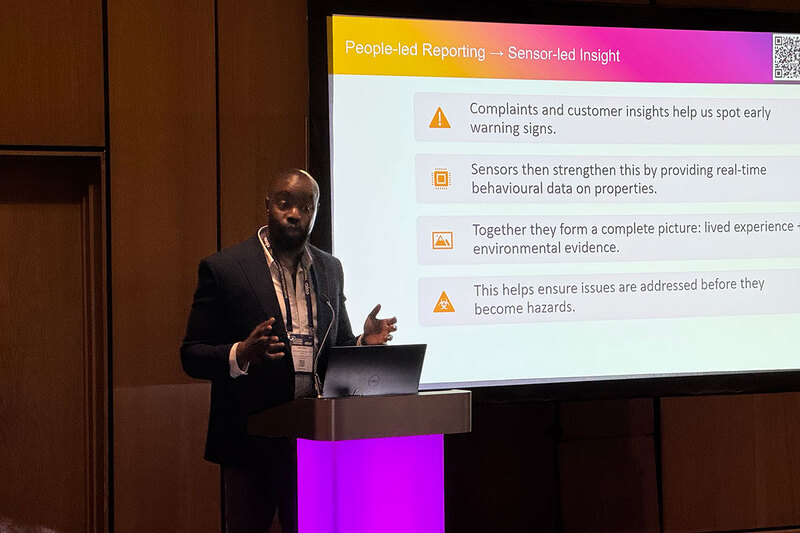
Several delegates raised serious concerns about the number of temporary accommodation placements their organisations might need to make to relocate (also known as ‘decant’) residents out of hazardous conditions. This is especially true as “more and more hazards come in” due to the phasing-in of the legislation, and require action from landlords within set legal timeframes.
The other major concern is ‘no access’ issues – ensuring compliance with Awaab’s Law when, as one delegate put it, “we know there is a hazard, but they [the resident] won’t let us in”.
Representatives from a number of housing providers said they are grappling with cases of ‘no access’, with many considering legal action to gain access in case they are found to be in breach of repairs timelines under Awaab’s Law.
Session leader Louise Murphy, partner and head of social housing at MSB Solicitors, reassured delegates that provided landlords have made “reasonable endeavours” to gain access to properties within the legal timeframes – and, crucially, have evidence of these attempts – they will have a defence against any alleged breach.
Subscribe to Inside Housing Management and sign up to the weekly newsletter
Inside Housing Management is the go-to source for learning, information and ideas for housing managers.
Subscribe here to read the articles.
Already have an account? Click here to manage your newsletters.
Related stories